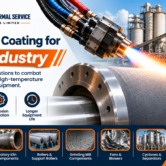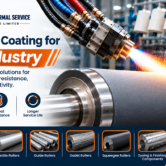
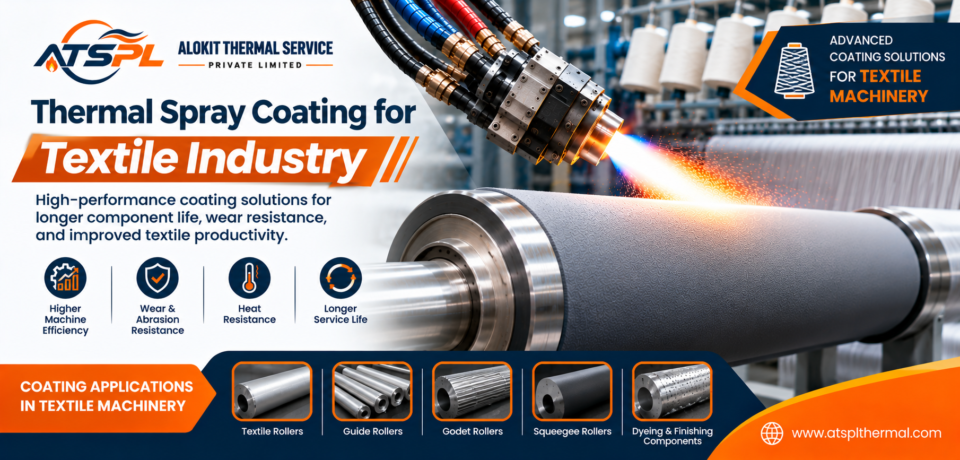
Thermal Spray Coating for Textile Industry
The textile industry depends on high-performance machinery, precision rollers, cylinders and rotating components to maintain production quality and operational efficiency. During continuous manufacturing operations, these components experience friction, abrasion, corrosion, surface wear and mechanical stress. Over time, surface deterioration can affect fabric quality, production speed and equipment performance.
Thermal Spray Coating for Textile Industry provides an advanced surface engineering solution to improve the durability and performance of selected industrial components. By applying protective metallic, ceramic or carbide coatings, manufacturers can improve surface properties, reduce wear and potentially extend component service life.
Alokit Thermal Service Pvt. Ltd. (ATSPL), based in Ahmedabad, Gujarat, India, provides specialized thermal spray coating and industrial surface engineering solutions. Its capabilities include HVOF coating, Arc Spray, Plasma Spray, component restoration and roller and cylinder reclamation.
What Is Thermal Spray Coating for Textile Industry?
Thermal spray coating is a surface engineering process in which metallic, ceramic, carbide or alloy materials are heated and deposited onto a prepared component surface.
The deposited material forms a protective layer designed to improve specific surface characteristics, including wear resistance, corrosion resistance, abrasion resistance and durability.
Thermal Spray Coating for Textile Industry is useful for selected textile machinery components that require reliable surface performance during continuous production.
Depending on the application, coating materials may include:
- Tungsten carbide
- Chromium carbide
- Stainless steel alloys
- Nickel-based alloys
- Molybdenum
- Bronze and brass
- Ceramic materials
The appropriate coating depends on the component material, operating environment, friction conditions, surface finish and production requirements.
Why Is Thermal Spray Coating Important for Textile Mills?
Textile manufacturing involves continuous mechanical operations, where rollers, shafts, cylinders and other components must maintain consistent surface quality.
Without suitable protection, these components may experience wear, dimensional changes and surface deterioration.
Professional Thermal Spray Coating for Textile Industry applications can help address several challenges.
1. Improved Wear Resistance
Textile machinery components operate continuously and may experience friction, abrasion and mechanical contact.
Suitable thermal spray coatings can improve surface hardness and wear resistance, helping protect components against premature deterioration.
2. Better Surface Durability
Rollers and cylinders require appropriate surface characteristics to support consistent manufacturing operations.
Application-specific coatings can improve surface durability and help maintain component performance.
3. Corrosion Protection
Moisture, chemicals and environmental exposure can contribute to corrosion in textile manufacturing facilities.
Suitable metallic coatings can provide additional protection for selected components.
4. Reduced Maintenance Requirements
When correctly selected and applied, thermal spray coatings can reduce surface deterioration and potentially decrease the frequency of component repair or replacement.
5. Extended Component Service Life
Protecting critical machinery surfaces can help improve component durability and support longer operating life.
Major Applications of Thermal Spray Coating in Textile Industry
Thermal Spray Coating for Textile Industry can be considered for several industrial machinery components, depending on their operating conditions and surface requirements.
1. Textile Machine Rollers
Rollers are essential components in textile manufacturing processes. They support material movement, feeding, guiding and processing operations.
Continuous operation can cause surface wear and dimensional deterioration.
Suitable thermal spray coatings can improve roller surface durability and provide protection against specific wear mechanisms.
2. Industrial Cylinders
Cylinders used in textile machinery require consistent surface characteristics for reliable operation.
Thermal spray coating may be considered where a cylinder requires wear protection, surface restoration or specialized surface properties.
3. Guide Rollers and Shafts
Guide rollers and shafts experience repeated mechanical contact and rotational movement.
Appropriate coatings can help improve resistance to wear and protect selected surfaces against deterioration.
4. Bearing Journals
Bearing journals are important rotating component surfaces. Wear or dimensional damage can affect alignment and mechanical performance.
Thermal spray build-up may be considered for suitable worn bearing journals, followed by precision grinding and finishing.
5. Rewinder and Winder Rolls
Winder and rewinder rolls are used in continuous material handling and processing operations.
Their surfaces must maintain suitable performance characteristics to support reliable production.
Depending on the operating requirements, protective coatings or restoration processes may help maintain component condition.
Roller and Cylinder Reclamation for Textile Machinery
One of the important applications of thermal spray technology is industrial component restoration.
Instead of replacing an entire roller or cylinder when its surface becomes worn, suitable components may be restored through thermal spray build-up and precision finishing.
ATSPL provides Roller & Cylinder Reclamation services involving surface preparation, thermal spray build-up, wear-resistant coating and precision finishing.
The process can help restore selected worn rollers, cylinders and bearing journals to specified drawing dimensions.
Typical applications listed by ATSPL include:
- Paper mill MG cylinders
- Dryer cylinders
- Rewinder and winder rolls
- Roller press bearing journals
- Conveyor drums and pulleys
- Industrial rollers
For textile manufacturers, similar restoration approaches may be evaluated for compatible rollers and rotating components after technical assessment.
Types of Thermal Spray Coating Technologies
Different thermal spray technologies offer different coating characteristics. The right process should be selected according to the component’s requirements.
1. HVOF Coating
High Velocity Oxy-Fuel (HVOF) is an advanced thermal spray process used to produce dense coatings with strong bonding characteristics.
HVOF coatings are commonly considered for components requiring high wear and abrasion resistance.
Tungsten carbide and chromium carbide coatings can be evaluated for suitable textile machinery components exposed to severe wear.
Learn more about HVOF Coating Services.
2. Arc Spray Coating
Arc Spray uses an electric arc to melt metallic wires and deposit the material onto a prepared surface.
It is commonly used for selected metallic coating applications, including corrosion protection and surface engineering.
3. Plasma Spray Coating
Plasma Spray uses a high-temperature plasma jet to deposit ceramic and metallic coating materials.
It can be considered for specialized applications requiring particular thermal, wear or surface properties.
Learn more about ATSPL’s Thermal Spray Process.
Benefits of Thermal Spray Coating for Textile Machinery
Choosing suitable Thermal Spray Coating for Textile Industry applications can provide several potential advantages:
- Improved wear and abrasion resistance
- Better surface durability
- Protection against selected corrosion conditions
- Restoration of suitable worn components
- Improved dimensional accuracy after finishing
- Potentially longer component service life
- Reduced replacement requirements
- Lower maintenance expenditure
- Improved machinery reliability
- Support for consistent production performance
Actual benefits depend on the component, coating material, application process, surface preparation and operating environment.
Thermal Spray Coating Process
A professional coating application involves several important stages.
1. Component Inspection: The component is inspected to identify wear, damage, material type and dimensional requirements.
2. Surface Preparation: The surface is cleaned and prepared to achieve suitable coating adhesion.
3. Coating Selection: The appropriate coating material and thermal spray technology are selected according to operating requirements.
4. Coating Application: The selected material is applied using an appropriate process such as HVOF, Arc Spray or Plasma Spray.
5. Precision Finishing: Grinding or machining may be performed to achieve the specified dimensions and surface finish.
6. Quality Inspection: Coating thickness, hardness, bond characteristics and surface condition can be inspected according to project requirements.
Why Choose ATSPL for Thermal Spray Coating in India?
Alokit Thermal Service Pvt. Ltd. (ATSPL) specializes in industrial thermal spray coating and surface engineering solutions.
Based in Ahmedabad, Gujarat, ATSPL provides coating and component restoration services for industries that require improved wear resistance, corrosion protection and equipment durability.
Its published capabilities include:
- HVOF coating
- Tungsten carbide wear coating
- Thermal Spray Aluminium
- Thermal Spray Zinc
- Plasma Spray
- Arc Spray
- Roller and cylinder reclamation
- Component restoration and specialty coatings
ATSPL follows an application-focused approach, evaluating component requirements and selecting appropriate coating technologies.
The company’s roller and cylinder reclamation service includes thermal spray build-up, hard coating and precision finishing for selected industrial components.
Explore Component Restoration & Specialty Coatings to learn more.
Frequently Asked Questions
1. What is Thermal Spray Coating for Textile Industry?
Thermal Spray Coating for Textile Industry is a surface engineering process used to improve the wear resistance, durability and surface performance of selected textile machinery components. Thermal Spray Coating for Textile Industry
2. Which textile machinery components can be coated?
Suitable rollers, cylinders, shafts, bearing journals and other mechanical components may be evaluated for thermal spray coating. Thermal Spray Coating for Textile Industry
3. What is the benefit of thermal spray coating on textile rollers?
Suitable coatings can improve roller wear resistance, protect surfaces against deterioration and potentially extend component service life. Thermal Spray Coating for Textile Industry
4. Can worn textile rollers be restored?
Some worn rollers may be suitable for restoration using thermal spray build-up and precision finishing, depending on their material and condition. Thermal Spray Coating for Textile Industry
5. What coating materials are used for industrial rollers?
Depending on the application, materials may include tungsten carbide, chromium carbide, stainless steel alloys, nickel-based alloys, molybdenum and ceramics. Thermal Spray Coating for Textile Industry
6. Is HVOF coating suitable for textile machinery?
HVOF can be considered for compatible textile machinery components requiring improved wear and abrasion resistance. Thermal Spray Coating for Textile Industry
7. Can thermal spray coating reduce machinery maintenance costs?
Properly selected coatings may reduce component deterioration and replacement frequency, potentially lowering maintenance costs. Thermal Spray Coating for Textile Industry
8. Does ATSPL provide roller and cylinder reclamation?
Yes. ATSPL provides roller and cylinder reclamation involving thermal spray build-up, wear-resistant coatings and precision finishing for suitable industrial components. Thermal Spray Coating for Textile Industry
9. Where is ATSPL located?
Alokit Thermal Service Pvt. Ltd. is located in Ahmedabad, Gujarat, India.
10. How can I contact ATSPL for thermal spray coating services?
You can contact ATSPL through its official website to discuss component details, operating conditions and coating requirements.