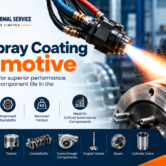
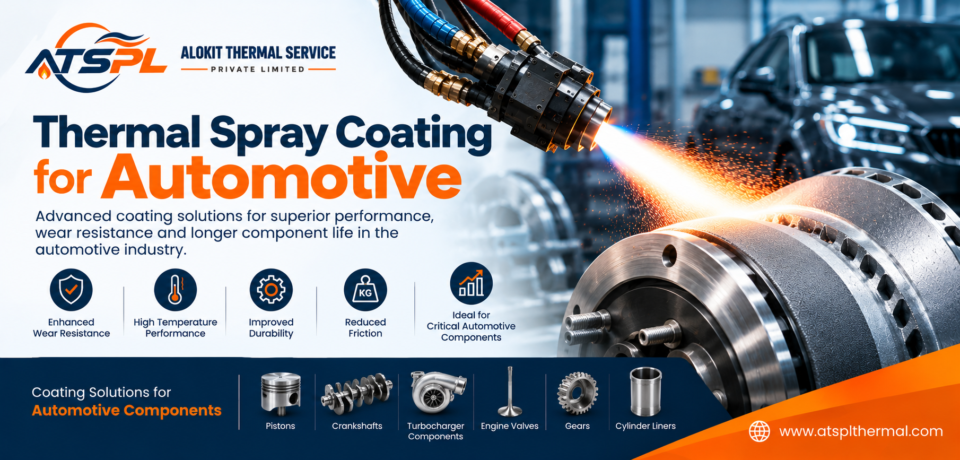
Thermal Spray Coating for Automotive
The automotive industry depends on precision-engineered components that must withstand friction, wear, abrasion, heat, corrosion, and continuous mechanical movement. As vehicle performance requirements increase, manufacturers and component suppliers need advanced surface engineering technologies to improve durability and reliability. Thermal Spray Coating for Automotive is one such technology that can enhance the surface properties of selected automotive components while helping extend their operating life.
Thermal Spray Coating for automotive parts involves applying metallic, ceramic, carbide, or alloy-based materials onto a prepared component surface. Depending on the application, the coating can improve resistance to wear, abrasion, erosion, corrosion, oxidation, and sliding contact.
Alokit Thermal Service Pvt. Ltd. (ATSPL) specializes in thermal spray and surface engineering technologies, including HVOF, Plasma Spray, Arc Spray, Thermal Spray Aluminium, and tungsten carbide coatings. Its capabilities are designed for demanding industrial components and can be evaluated for suitable automotive applications.
What Is Thermal Spray Coating for Automotive?
Thermal Spray Coating for Automotive is a surface engineering process used to deposit a protective coating onto selected automotive components. During the process, coating material is heated or partially melted and accelerated toward a prepared substrate. The particles impact the surface and form a protective coating layer.
The objective is not necessarily to change the complete component. Instead, Thermal Spray Coating for automotive parts focuses on improving the performance of the component’s working surface.
Depending on the automotive application, coatings can be selected to provide:
- High wear resistance
- Abrasion resistance
- Sliding-wear protection
- Corrosion resistance
- Erosion resistance
- High surface hardness
- Reduced friction
- Improved surface durability
- Dimensional restoration
The appropriate coating depends on the component material, operating temperature, contact conditions, load, speed, lubrication, wear mechanism, and required surface finish.
Why Is Thermal Spray Coating Important for the Automotive Industry?
Automotive components frequently experience repeated mechanical movement and contact. Shafts rotate continuously, hydraulic components operate under pressure, engine-related components experience heat, and transmission and drivetrain components are exposed to friction and wear.
Using Thermal Spray Coating for Automotive applications can help engineers improve the surface performance of suitable components without redesigning the entire part.
Potential benefits include:
Improved Wear Resistance
Wear-resistant coatings can help protect component surfaces exposed to repeated contact, friction, or abrasive conditions.
Extended Component Service Life
A properly selected coating can reduce surface deterioration and potentially increase the service life of suitable automotive parts.
Improved Corrosion Protection
Certain thermal spray materials can provide protection against corrosive environments, depending on the application.
Dimensional Restoration
Thermal spray processes can be used for selected component restoration applications, where worn surfaces are rebuilt and subsequently finished to required dimensions.
Reduced Maintenance
More durable surfaces can potentially reduce maintenance requirements and premature component replacement.
How Does Thermal Spray Coating for Automotive Parts Work?
A professional Thermal Spray Coating for automotive parts project normally involves several stages.
1. Component Assessment
The component is evaluated to determine its substrate material, dimensions, surface condition, operating environment, and type of wear.
2. Surface Preparation
The surface is cleaned, degreased, and prepared before coating. Proper surface preparation is essential for achieving suitable coating adhesion and performance.
3. Coating Material Selection
The coating material is selected according to the application’s requirements. Possible materials include tungsten carbide, metallic alloys, ceramics, and other specialized coating materials.
4. Thermal Spray Application
The selected coating is applied using an appropriate thermal spray process such as HVOF, Plasma Spray, Arc Spray, or another suitable technology.
5. Finishing
After coating, the component may require grinding, machining, polishing, or other precision finishing to achieve the required dimensions and surface roughness.
6. Quality Inspection
The finished component can be evaluated for coating thickness, hardness, adhesion, surface condition, and other application-specific parameters.
ATSPL describes its thermal spray workflow as including component assessment, surface preparation, thermal spray application, and finishing and quality inspection.
HVOF Coating for Automotive Parts
HVOF (High Velocity Oxy-Fuel) is one of the most advanced thermal spray technologies available for demanding wear applications.
HVOF accelerates coating particles at high velocity toward the prepared component surface, creating a dense and strongly bonded coating. ATSPL applies tungsten carbide and chromium carbide coatings through HVOF for industrial components exposed to wear, abrasion, erosion, and corrosion.
For suitable Thermal Spray Coating for automotive parts applications, HVOF can be considered where high surface hardness and wear resistance are important.
ATSPL’s published HVOF specifications include micro-hardness up to 1400 HV, bond strength exceeding 10,000 PSI, porosity below 1%, and coating thicknesses up to approximately 2–3 mm for applicable systems.
Explore ATSPL HVOF Coating Services
Tungsten Carbide Coating for Automotive Applications
Tungsten carbide is recognized for its high hardness and resistance to abrasive, erosive, and sliding wear. ATSPL applies tungsten carbide coatings using HVOF technology for demanding wear applications, including screw conveyors, rewinder rolls, pump casings, shaft sleeves, and valve internals.
For automotive applications, tungsten carbide coating may be evaluated for suitable components where extreme surface wear resistance is required.
Explore Tungsten Carbide Wear Coating
Potential Automotive Applications of Thermal Spray Coating
The suitability of Thermal Spray Coating for Automotive depends on the component’s material, geometry, operating environment, and performance requirements.
Potential areas for evaluation include:
Shafts and Rotating Components
Rotating shafts can experience sliding wear, friction, and surface deterioration. Suitable thermal spray coatings can potentially improve the durability of working surfaces.
Hydraulic Components
Hydraulic cylinders and related components require controlled surface properties and resistance to wear and corrosion. Thermal spray technology can be evaluated for suitable hydraulic applications.
Bearing Journals
Bearing journals require precise dimensions and surface characteristics. Thermal spray processes can be used for selected restoration and surface-protection applications.
Rollers and Production Components
Automotive manufacturing plants use numerous rollers, tooling components, and production equipment. Wear-resistant thermal spray coatings can help protect suitable surfaces.
Engine and Powertrain Components
Certain engine and powertrain components operate under high temperatures, friction, and mechanical loads. Application-specific thermal spray solutions may be considered where technically appropriate.
Important: The correct coating should always be determined through technical evaluation rather than assuming that one coating is suitable for every automotive component.
Thermal Spray Coating for Automotive Parts Manufacturing
Automotive manufacturers and component suppliers increasingly focus on improving production efficiency and component durability. Thermal Spray Coating for automotive parts can become part of a broader surface engineering strategy where only the working surface needs enhanced performance.
The technology can be especially valuable when the base material provides the required structural strength while the coating provides additional surface properties such as hardness, wear resistance, or corrosion protection.
ATSPL’s broader thermal spray process supports metallic, ceramic, and carbide coatings and includes applications such as shafts, rotors, bearing journals, hydraulic cylinders, print rollers, and wear surfaces.
Component Restoration Using Thermal Spray Coating
Another potential advantage of Thermal Spray Coating for Automotive applications is component restoration.
A component that has lost material because of wear may sometimes be restored by depositing suitable coating material onto the affected surface. The coated area can then be precision-finished to achieve the required dimensions.
This approach can potentially reduce the need for complete component replacement and support more economical maintenance.
ATSPL offers component restoration and specialty coating services as well as roller and cylinder reclamation.
Explore Component Restoration & Specialty Coatings
Explore Roller & Cylinder Reclamation
Why Choose ATSPL for Thermal Spray Coating for Automotive Applications?
Alokit Thermal Service Pvt. Ltd. (ATSPL) has specialized in surface engineering since 2004 and provides high-performance thermal spray coating solutions designed to protect critical industrial assets against wear, abrasion, erosion, and corrosion.
ATSPL’s capabilities include:
- HVOF coating
- Tungsten carbide coating
- Thermal Spray Aluminium
- Thermal Spray Zinc
- Plasma Spray
- Arc Spray
- Component restoration
- Roller and cylinder reclamation
- Specialty surface coatings
The company follows an ISO 9001:2015 certified workflow and states that its quality-control process includes coating-thickness checks, micro-hardness testing, bond evaluation, and surface-condition inspection.
For automotive manufacturers, component suppliers, and engineering companies, ATSPL can evaluate specific component requirements and recommend an appropriate surface engineering approach where thermal spray technology is technically suitable.
How to Select the Right Thermal Spray Coating for Automotive Parts?
Before choosing Thermal Spray Coating for automotive parts, consider:
- Base material
- Component geometry
- Operating temperature
- Load and contact pressure
- Rotational or sliding speed
- Type of wear
- Corrosion exposure
- Lubrication conditions
- Required coating thickness
- Required surface hardness
- Surface roughness requirements
- Finishing and dimensional tolerances
A technical assessment should be performed before selecting the coating technology and material.
Frequently Asked Questions About Thermal Spray Coating for Automotive
1. What is Thermal Spray Coating for Automotive?
Thermal Spray Coating for Automotive is a surface engineering technology used to apply protective metallic, ceramic, carbide, or alloy coatings to suitable automotive components to improve surface performance.
2. What are the benefits of Thermal Spray Coating for automotive parts?
Potential benefits include improved wear resistance, abrasion protection, corrosion resistance, surface hardness, component durability, and restoration of selected worn surfaces.
3. Can HVOF be used for automotive parts?
HVOF can be evaluated for automotive components where high wear resistance, surface hardness, and coating density are required. Suitability depends on the component and operating conditions.
4. What materials can be used for automotive thermal spray coatings?
Potential materials include tungsten carbide, chromium carbide, metallic alloys, ceramics, and other specialized coating materials.
5. Can thermal spray coating restore worn automotive components?
Yes, selected worn components may be restorable through thermal spray deposition followed by precision finishing, provided the component and application are technically suitable.
6. Does thermal spray coating improve automotive component life?
A correctly selected and applied coating can reduce surface wear and potentially extend the service life of suitable automotive components.
7. What automotive parts can be coated?
Potential applications include selected shafts, bearing journals, hydraulic components, rotating surfaces, production rollers, and other wear-critical components.
8. Is tungsten carbide suitable for automotive applications?
Tungsten carbide provides high hardness and wear resistance and can be considered for automotive or automotive-manufacturing components where severe surface wear is present.
9. Does ATSPL provide thermal spray coating services in India?
Yes. ATSPL provides thermal spray and surface engineering services from Ahmedabad, Gujarat, India, including HVOF, tungsten carbide, Plasma Spray, Arc Spray, Thermal Spray Aluminium, and other coating solutions.
10. How can I contact ATSPL for automotive coating requirements?
You can contact ATSPL with details about the automotive component, base material, operating conditions, dimensions, wear mechanism, and required coating performance for a technical evaluation.