Thermal Spray Coating in Gujarat
Industries across Gujarat operate in demanding environments where machinery and components are continuously exposed to wear, abrasion, erosion, corrosion, high temperatures, and chemical attack. From power plants and steel industries to cement, oil & gas, chemical, and paper manufacturing, protecting critical components is essential for maintaining productivity and reducing unexpected downtime.
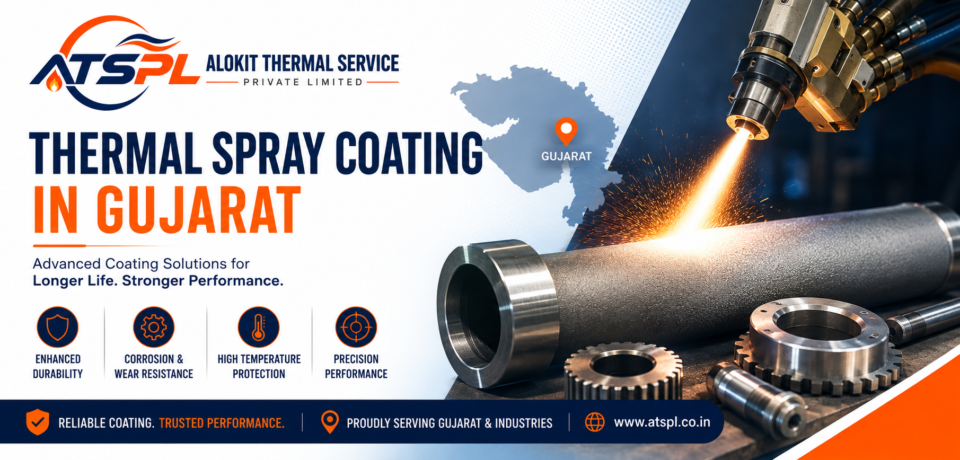
Thermal Spray Coating in Gujarat has emerged as an effective surface engineering solution for extending component life, improving equipment performance, and reducing maintenance and replacement costs. Alokit Thermal Service Pvt. Ltd. (ATSPL) provides specialized thermal spray coating and surface engineering solutions for industries requiring reliable protection under severe operating conditions.
What Is Thermal Spray Coating?
Thermal spray coating is a surface engineering process in which metallic, ceramic, carbide, or alloy materials are heated and accelerated onto a prepared component surface. The sprayed particles form a protective coating that improves the surface properties of the underlying component.
Unlike conventional manufacturing processes, thermal spraying allows engineers to improve the performance of a component without replacing the entire part. Depending on the application, the coating can provide enhanced resistance against abrasion, erosion, corrosion, oxidation, and sliding wear.
ATSPL offers advanced thermal spray technologies including HVOF, Arc Spray, Plasma Spray, and Thermal Spray Aluminium (TSA) to meet different industrial requirements.
Why Thermal Spray Coating Is Important for Gujarat Industries
Gujarat is one of India’s major industrial and manufacturing hubs, with extensive activity in power generation, steel, cement, chemicals, petrochemicals, engineering, oil & gas, and process industries. Equipment operating in these sectors often experiences aggressive service conditions.
Choosing Thermal Spray Coating in Gujarat can help industries:
- Improve wear and abrasion resistance
- Protect components against erosion
- Reduce corrosion-related damage
- Increase component service life
- Reduce equipment replacement frequency
- Minimize maintenance costs
- Reduce unplanned plant shutdowns
- Restore worn components to required dimensions
- Improve the reliability of critical machinery
- Support longer equipment operating cycles
The right coating system depends on factors such as operating temperature, material being processed, gas or fluid velocity, type of wear, chemical exposure, component material, and required coating thickness.
Types of Thermal Spray Coating Technologies
1. HVOF Coating
High Velocity Oxy-Fuel (HVOF) is an advanced thermal spray technology used for demanding wear and corrosion applications. The process accelerates coating particles at very high velocity, producing dense coatings with strong adhesion and low porosity.
ATSPL applies HVOF coatings such as tungsten carbide and chromium carbide for applications involving valves, shafts, rollers, pump components, turbine parts, compressor components, and other critical industrial equipment.
HVOF coatings are particularly suitable when high wear resistance, low porosity, and strong coating adhesion are required.
Explore ATSPL’s HVOF Coating Service
2. Thermal Spray Aluminium
Thermal Spray Aluminium (TSA) is commonly used where corrosion protection is a major requirement. Aluminium is thermally sprayed onto a properly prepared surface to create a protective layer.
TSA can be valuable for industrial structures and components exposed to corrosive environments, particularly where long-term surface protection is required.
3. Arc Spray Coating
Arc Spray uses an electric arc to melt metallic coating materials before they are atomized and projected onto the component surface. It is suitable for corrosion protection and selected wear applications.
Arc spray can provide an efficient coating solution for large surfaces and industrial components where productivity and corrosion resistance are important.
4. Plasma Spray Coating
Plasma spraying uses a high-temperature plasma stream to melt and propel coating materials onto a component. It can be used with metallic and ceramic materials and is suitable for specialized applications requiring thermal, wear, or surface-performance improvements.
Applications of Thermal Spray Coating in Gujarat
The versatility of thermal spray technology makes it suitable for numerous industrial applications throughout Gujarat.
Power Generation
Power plants operate with high temperatures, high-velocity gases, ash, and abrasive particles. Boiler tubes, turbine components, and other critical surfaces can experience severe erosion and wear.
ATSPL provides in-situ boiler tube anti-erosion coating solutions designed for demanding CFBC and PC boiler environments.
Steel & Metallurgy
Steel manufacturing involves high temperatures, abrasive materials, heavy mechanical loads, and continuous production. Thermal spray coatings can help protect rollers, shafts, guides, and other critical components.
Cement Plants
Cement manufacturing generates highly abrasive conditions. Rollers, cylinders, shafts, and other components can suffer significant wear.
Thermal spray coatings can provide a protective surface while component reclamation can help restore worn parts rather than replacing them.
Oil & Gas
Oil & gas equipment can face corrosion, erosion, chemical exposure, and mechanical wear. Specialized coatings can help protect valves, shafts, pumps, and other components operating in challenging environments.
Chemical & Refinery Industries
Chemical processing equipment may be exposed to corrosive chemicals and elevated temperatures. Selecting an appropriate coating system can improve surface protection and contribute to longer component life.
Pulp & Paper
Paper mills depend on rollers, cylinders, and rotating equipment that require precise surface conditions. Thermal spray technology can be used for wear protection and dimensional restoration.
Thermal Spray Coating for Component Restoration
Thermal Spray Coating in Gujarat One of the major advantages of thermal spray technology is its ability to restore worn components.
Instead of immediately replacing an expensive roller, shaft, cylinder, or bearing journal, the damaged surface can potentially be rebuilt using a suitable thermal spray material and then precision-finished to the required dimensions.
ATSPL provides roller and cylinder reclamation services involving surface preparation, thermal spray build-up, hard coating, grinding, and finishing.
Learn More About Roller & Cylinder Reclamation
This approach can help industries reduce replacement costs and lead times while bringing valuable components back into operation.
How Does Thermal Spray Coating Work?
A professional thermal spray project generally involves several important stages:
1. Component Assessment:
The component is inspected to understand the type and severity of surface damage or wear.
2. Surface Preparation:
The surface is cleaned, degreased, and prepared to achieve appropriate coating adhesion.
3. Thermal Spray Application:
The selected coating material is applied using the most suitable technology, such as HVOF, Arc Spray, Plasma, or TSA.
4. Finishing:
The coated component can be ground or finished according to dimensional and surface requirements.
5. Quality Inspection:
Coating thickness, adhesion, hardness, surface condition, and other relevant parameters are evaluated.
This systematic approach helps ensure that the coating is suitable for the component’s actual operating environment.
Why Choose ATSPL for Thermal Spray Coating in Gujarat?
Alokit Thermal Service Pvt. Ltd. (ATSPL) specializes in thermal spray coating and surface engineering solutions for demanding industrial applications. The company has been providing surface protection solutions since 2004 and focuses on extending equipment life while reducing maintenance requirements.
ATSPL’s capabilities include HVOF coating, thermal spray aluminium, thermal spray zinc, tungsten carbide wear coatings, in-situ boiler tube coatings, component restoration, and roller & cylinder reclamation.
The company also follows an ISO 9001:2015 certified workflow and performs quality checks such as coating thickness, micro-hardness, and bond evaluation.
For industries searching for Thermal Spray Coating in Gujarat, ATSPL can provide application-specific solutions based on component material, operating conditions, wear mechanism, and required performance.
Benefits of Professional Thermal Spray Coating
Selecting the correct coating is only one part of a successful surface engineering project. Proper surface preparation, spray parameters, coating material, finishing, and inspection are equally important.
A professionally executed coating solution can provide:
- Better component durability
- Improved resistance to abrasive wear
- Enhanced erosion protection
- Improved corrosion resistance
- Reduced maintenance requirements
- Lower lifecycle costs
- Extended machinery operating life
- Reduced component replacement
- Improved equipment reliability
Frequently Asked Questions About Thermal Spray Coating in Gujarat
What is Thermal Spray Coating?
Thermal spray coating is a surface engineering technique used to deposit metallic, ceramic, carbide, or alloy materials onto a component to improve properties such as wear resistance, corrosion protection, and surface durability.
Which industries use thermal spray coatings?
Thermal spray coatings are used across power generation, steel, cement, oil & gas, chemicals, refineries, pulp & paper, mining, and other process industries.
What is HVOF coating used for?
HVOF coating is commonly used for demanding wear and corrosion applications. Tungsten carbide and chromium carbide coatings are frequently selected for components exposed to severe mechanical wear.
Can thermal spray coating restore worn components?
Yes. Suitable thermal spray processes can be used to rebuild worn surfaces on certain components, followed by precision grinding and finishing.
How do I select the right coating?
The coating should be selected according to the component material, wear mechanism, temperature, corrosion environment, operating conditions, required thickness, and performance objectives. A professional coating service provider can assess these factors and recommend an appropriate solution.